
Landing Page vs Website: Which One Does Your Business Need to Get More Leads?
A website and a landing page do different jobs. Using the wrong one, especially for ads, is one of the most common reasons campaigns don't bring leads.

Many business owners spend on Google or Facebook ads, see plenty of clicks, and still wonder why the phone isn't ringing. Very often, the ads are fine. The problem is where they send people.
What is a website?
Your website is your complete online home. It explains everything: all your services, your story, your team, your work, your location, your blog. Visitors explore it in different ways. Some read the about page, some go straight to prices, some check reviews.
That variety is its strength. A website builds trust with people at every stage, ranks in Google for many different searches and gives AI assistants enough information to describe your business accurately.
What is a landing page?
A landing page is a single page with one job. It is usually built for a specific campaign: a Diwali offer, a free consultation, a new course batch, a seasonal service. It has:
- One headline that matches the ad the visitor clicked.
- A short explanation of the offer and its benefits.
- Proof such as reviews or photos.
- One clear action, usually a short form, call button or WhatsApp button.
- Very few links away from the page, so attention isn't lost.
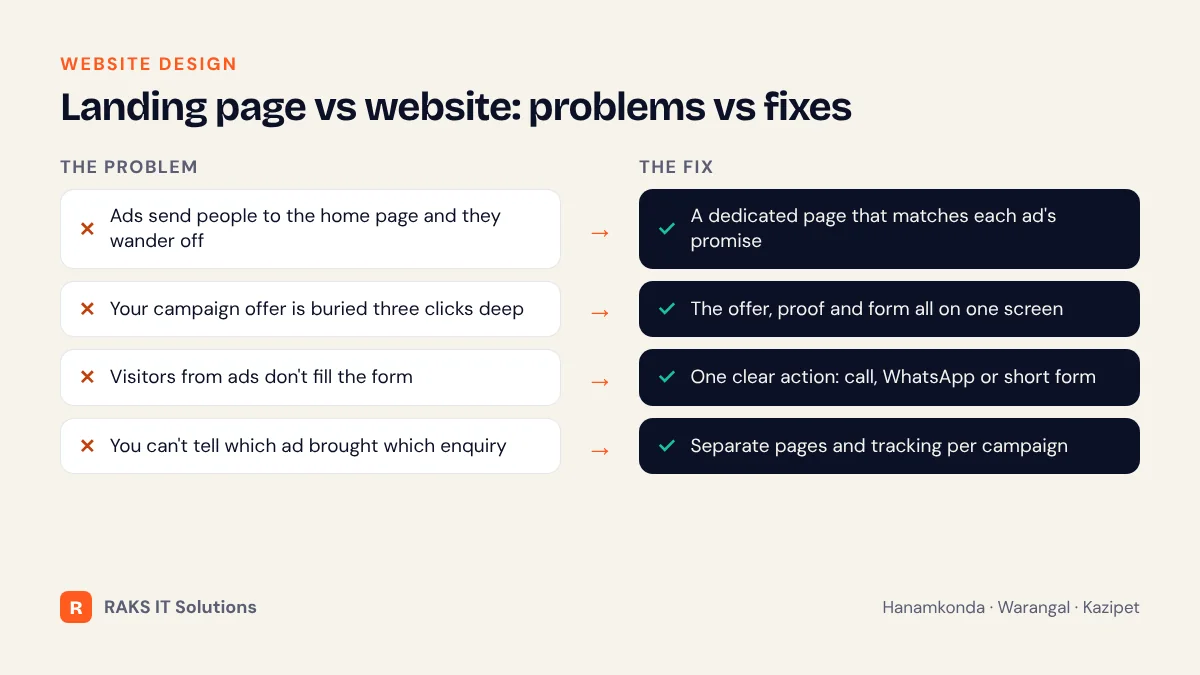
Why sending ads to your home page often fails
Your home page tries to speak to everyone. Someone who clicked an ad for "AC repair in Hanamkonda" lands on a page that talks about your history, five other services and a newsletter signup. They have to hunt for what they came for. Many don't bother.
A landing page that says "AC repair in Hanamkonda, same-day visits" with a call button right there keeps the promise the ad made. That consistency is what turns clicks into leads.
When you need a full website
- You want to rank on Google for your services and area.
- Customers usually research before buying (healthcare, education, real estate, B2B).
- You offer several services that each deserve their own page.
- You want a long-term asset that grows in value with content and reviews.
When you need a landing page
- You're running paid ads for one specific service or offer.
- You're launching something new and want to test interest quickly.
- You have a time-bound promotion or event.
- You want to measure exactly how one campaign performs.
The answer for most businesses: both, working together
The strongest setup is a solid website as the base, with focused landing pages for campaigns. The website carries your search rankings and reputation. Landing pages capture campaign traffic efficiently. Each landing page can still link to your main site for people who want to know more, but its main focus remains the action.
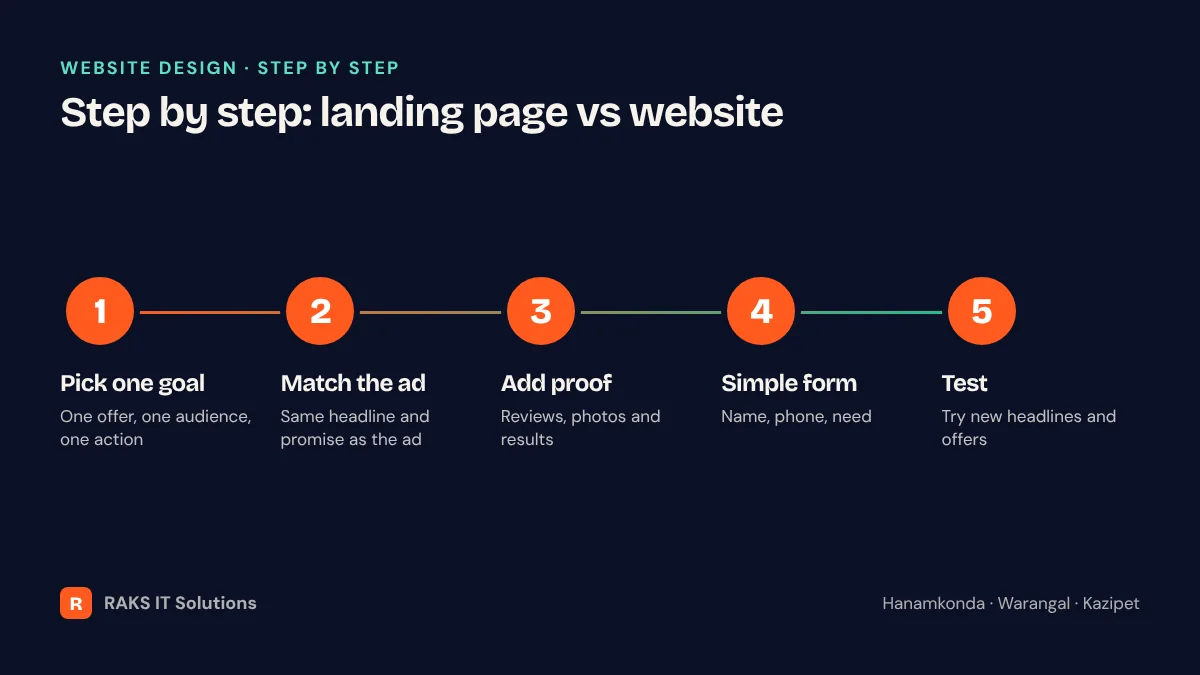
How to build a landing page that converts
- Write the headline from the customer's side. What problem do they want solved?
- Keep the form short. Name, phone and one question is often enough.
- Show proof close to the action. A review next to the button reduces doubt.
- Make it fast on mobile. Ad visitors are mostly on phones.
- Track every lead. Connect the page to Google Analytics, your ad accounts and your CRM so you know the cost per enquiry.
- Test one change at a time. Headline, offer, image or button text.
The bottom line
A website and a landing page aren't competitors. The website earns trust and organic visibility; the landing page turns paid attention into enquiries. If your ads are getting clicks but not calls, the page they land on is the first thing to fix. See how we plan both in our website design and development service.

